Orwell, George. The Animal Farm. London: Secker and Warburg, 1945

“All animals are equal, but some animals are more equal than others” – The one commandment that remained painted on the top of the barn of Manor Farm summarizes the essence of the masterpiece crafted by the king of dystopia, George Orwell. Orwell’s book is a commentary on the 1917 Russian Revolution which had put on a façade as a step towards democratic socialism, however, was anything but. As a literary text Orwell has managed well to infuse elements of anthropomorphism, lyrical verses and allegory into a perfect blend of aesthetic delight. The story reimagines and redefines the societal structure of a nation and the subtle mechanisms that act as a tool of manipulation. Orwell has very cleverly and slyly deconstructed the way we envisage our role in a society and the false notion of security that citizens of a democracy live under.

The story begins with a vivid description of the farm which is the primarily where it revolves around. It also sketches a detailed picture of Mr. Jones who owns the farm at the beginning of the story, he is said to be the allegorical figure of Tsar Nicholas II – the last emperor of Russia who was slain along with his entire family by the Bolsheviks. Quite the same is the fate of Jones who is overthrown out of his farm by the animals he had owned. This also shows Orwell’s discipline in respecting the timeline of events and structuring the literature along that line. The story’s rising action is clearly distinguishable with the introduction of most of the major characters. First comes the allegorical character of the Old Major, who is an amalgamation of the Marxist philosophy and the communist ideology of Lenin, brought into life by Orwell. Then come the two major characters – Napoleon and Snowball who are the leaders of “The Battle of Cowshed”, which was instigated by Old Major’s dying words. Napoleon being the allegory of the cunning Joseph Stalin and Snowball being the embodiment of Leon Trotsky. The introduction of supporting characters such as Squealer, Boxer, Mollie, Clover, Benjamin, Muriel and other animals are done in a manner of roundness and gradualism. We begin to feel, read, understand and empathize with these characters only from the point where Napoleon becomes the self-proclaimed leader of Animal Farm after driving out the charismatic Snowball and somehow proving him to be guilty of treachery and treason. The novel grows darker and deeper, and as readers we see the rest of the story through the perspective of these characters who are repressed by the dogs brought up under Napoleon’s guidance. The novel closes with Clover’s discovery of Napoleon feasting with Mr. Frederick – the representation of Adolf Hitler, Mr. Pilkington and Mr. Whymper and walking on two legs while the sheep chant – “Four legs good, two legs better!”

It is interesting to see how Orwell manages to manifest his views in the form of a novel out of a simple idea, which he mentions in the preface of his book:

“….I saw a little boy, perhaps ten years old, driving a huge carthorse along a narrow path, whipping it whenever it tried to turn. It struck me that if only such animals became aware of their strength we should have no power over them, and that men exploit animals in much the same way as the rich exploit the proletariat.”

 The humbleness of origins that we find in Orwell’s novel is not just inspiring but reiterates the notion that stories can be found in the most unusual of places only if one looks for it. Animal Farm also manages to raise an important question of the fate of a revolution, if it can truly ever be successful in the utilitarian world? Or is it doomed for failure? What the readers can take away from this novel is to have a highly realistic approach towards a certain ideology instead of meandering around in dreams of utopia. After reading the book, one is reminded of what Adolf Hitler had once proclaimed – “If you do not like a rule… Just follow it … Reach on top… And change the rule” – which seems to be the only path towards reaching a point of political contentment. The farm itself is a space of subjugation, hard labour and production, which implies that all the elements that exists in a society of human beings are there to be employed for benefit. This conception exists dominantly in the contemporary scenario where the power of a nation state is determined by the ability to produce rather than the condition of its residents.  

            In popular culture, there is a trend to draw references to literary classics. Animal Farm is one of the most popularly referred to literary text in popular culture. Cartoon shows such as X-men and Jonny Bravo; Bands such as Pink Floyd and Radiohead; And Television shows such as Oz and Lost are known to have made use of certain elements of the novel. This shows that the narrative continues to be socially and politically relevant. Also, it’s an indication of the impact that the novel has made on the world of literature.

            Animal Farm continues to be a subject of great debate amongst academicians and political thinkers which verifies Orwell’s credentials as one of the greatest literary writers of the world.   

Works Cited

1.    Moran, Daniel. CliffsNotes on Animal Farm. 20 Nov 2015

2.    Shmoop Editorial Team. "The Characters in Animal Farm." Shmoop. Shmoop University, Inc., 11 Nov. 2008. Web. 21 Nov. 2015.

3.    Newsinger, John. Europe-Asia Studies 48.7 (1996): 1264–1265. Web...

4.    Kirschner, Paul. “The Dual Purpose of "animal Farm"”. The Review of English Studies 55.222 (2004): 759–786. Web...


-Srinjoy Dey


Let us go then, you and I,
To the chamber where we were born and bred
Festooned now with cobwebs,
The crib but a wreck,
That once buoyed us through languid streams,
Has now sunken to Time’s deepest depths-
Tempest tossed by Time’s unforgiving winds.


Let us go then, you and I,
To every threshold,
Where we stumbled, tripped and fell,
But rose again, standing tall and firm,
To every threshold- that we crossed together,
With friends and foes,
Winning and losing,
Loving and hating,
Living and dying.


Let us go then, you and I,
Down the vista of bygone years,
And relive times of triumphs and fears,
Smiles and tears,
Loss and gain,
Summer and rain,
Joy and pain.


Let us go then, you and I,
Rise from the darkened spirals of the past,
To those of the ‘morrow,
Let us embark then, on a journey onward,
Into the vast and endless seas,
Carrying in our pockets fragments of that dear crib,
And in our cargo,
Memories of those years gone by.


-Sambhavi Sudhakar


The cold rain falls incessantly,

The thunders roll on without a stop.

Outside, the temperature drops,

as the rage of the storm thrashes about.


The raindrops hit against the windows,

threatening to shatter the glass.

The fire crackles beneath the fireplace,

as I stare at the clock counting hours.


My eyes fall on the piano,

looking grand across the hallway.

I wish you were here to play our song,

The one you always did on my birthday.


I run my hands on the slippery keys,

and press a few out of curiosity.

And before I know, I begin to play,

The song you always did on my birthday.


The music spreads like a forest fire,

And the voices in my heart are set free.

The notes touch each nerve in my brain,

and my heart connects in pure symphony.


The storm doesn't bother me,

I don't mind the rain anymore.

I can't hear the raindrops fall,

The bursting clouds don't scare me at all.


The thunder rumbles throughout the night,

And the streets overflow with water.

The lightning flashes and the fire burns,

But the waves of joy fail to falter.


I wake up stiff and tired,

I'd slept near the piano all night.

Pulling the curtains aside, I smile,

At the first rainbow in the morning sky.

- Jasmine John


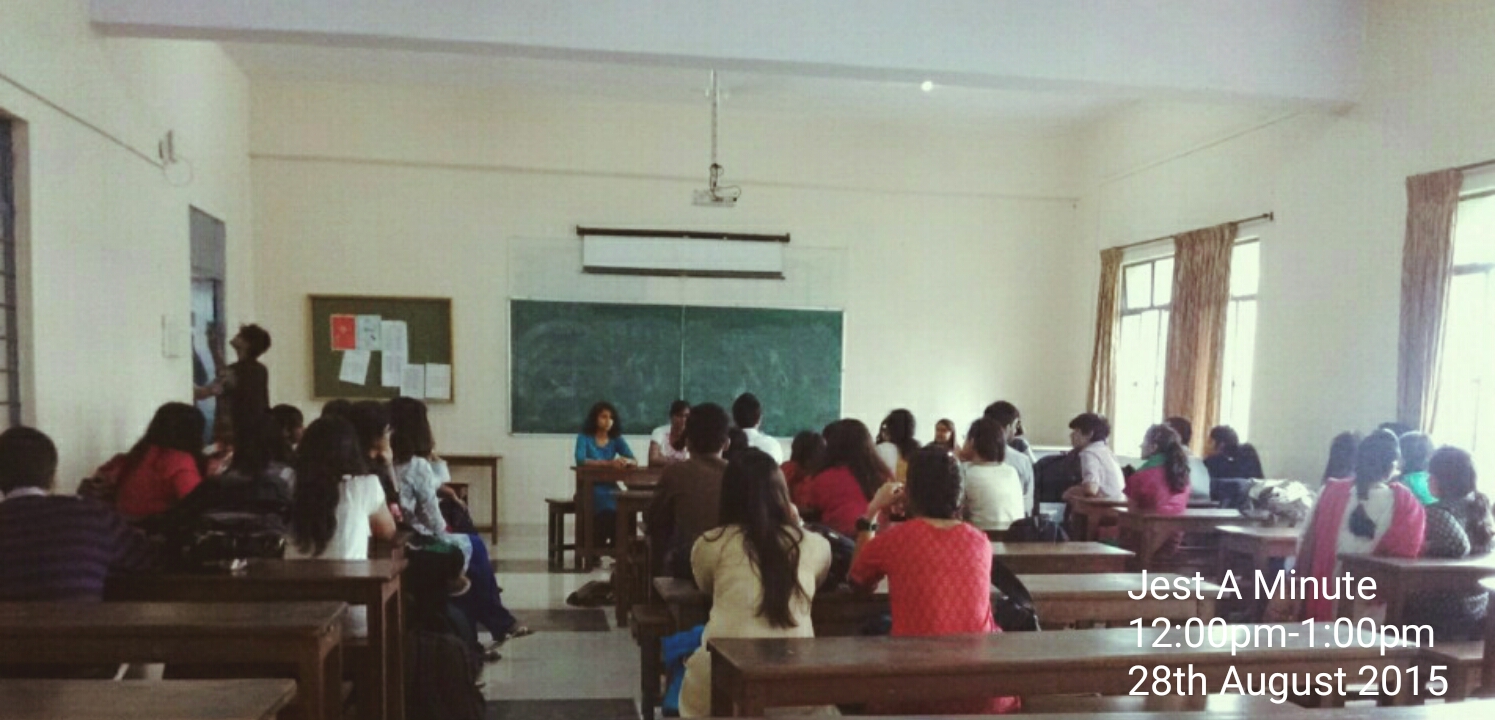
‘Jest a Minute’, conducted by The Literati, was the first official debate event hosted by the same. It served as an apt prelude to the series of debate-related events The Literati intends to conduct. The event was held on Friday, 28 August 2015, between 12 and 1 pm in the afternoon, in the classroom II JPEP, Block 1. The venue was packed with over fifty students, inclusive of both participants and the audience. There was a generous mix of students from various departments.
The Jam Master for the day was Brian Tom. He is a fellow student at Christ University and is currently pursuing his Bachelor of Commerce. He is a member of the Cultural Team, having won first place in JAM in the intra-collegiate fest “Darpan”, and has also participated in several inter-collegiate fests.
The event began with the Jam Master proposing the topic ‘Jam is Not My Bread and Butter’, which set the tone for the first round of the JAM. A perfect blend of humor, thrill and exhilaration went into fuelling the students’ enthusiastic involvement in the event. There was a good deal of friendly banter combined with a competitive spirit that enlivened the event. 

The second round began with the proposition of the topic ‘You are a Marvellous Book in a Sea of Twilight and Shades of Grey’. The excitement stayed intact as we traversed a wide range of bizarre topics such as ‘Atheism is a Non- Prophet Organisation’. The Jam Master came up with a unique rule in the course of this round, which entailed singing a song before stating one’s opponent’s mistakes. 
With the conclusion of the second round, the participants who had qualified for the finals were decided. The finale of this event is to be held on the 9 September 2015.
With this, came to an end, the first official debate event held by The Literati. It has been successful in igniting the zeal of both organizers and participants alike, and has certainly set the keynote for future events.

- Sambhavi Sudhakar
II PSEng

Students begin to open their eyes to what cinema truly is.


The Literati presented its second film screening on Friday, 7 August 2015 at 12 pm in I PCM, Block 1. Around 25 students were left with a feel-good warmth after attending the screening of a movie called “Where is the Friend’s Home?”, one of the earlier works of Iranian film director, Abbas Kiarostami, which was inspired by a poem by Sohrab Sepehri, followed then by a Question and Answer session.

Being one of his most celebrated works, with the British Film Institute including the same as part of its top 50 movies to be watched before turning 14, it explores the metaphors of loyalty and civil duty, through a rather simple tale of a schoolboy wanting to return his friend’s notebook, failing which the latter would be subject to penalisation in school.

With the Q&A session moderated by Christ University’s very own Prashant from II MA Eng, the audience was challenged to ‘read a film’ like any other book, looking beyond the regular parameters, students generally set themselves, when it comes to cinema, like the story or the actors’ performance.

The film screening session on Friday gave insight to the students that films are primarily a visual medium of communication, highlighting the significance of cinematography and editing as a means to convey an idea and bring about emotions from the audience.

The audience gained a new found respect for Abbas Kiarostami’s simple style of cinema that transcends barriers while not being gimmicky or pretentious.

It doesn't matter if you missed this screening, we will be having another one (or two) in the month of September. We will keep you updated.

-         Mohammed Essam, I CEP
The Literati says hello to its first Poetry-reading session

The first poetry reading session by The Literati was held on Wednesday, 5 August 2015 at Room 116 (I PSEng), Block 1. The participants recited the poems they wrote and explained their contexts after the recitation. With over 12 participants and 30 people as audience, the first session was indeed fruitful. The theme of the poems ranged from personal anecdotes of love, longing and self-validation to vivid experiences and epiphanies.  From musings of a bored back-bencher to inspirational pieces of strength and hope, the writings were thoroughly varied and stimulating.

"I promise the world is not that dark a place. It may be unfamiliar, but it’s yours to reach out, explore and dare" said Jasmine Yadav. A performing arts student, with provocative buoyancy, had kindled the hope in our hearts with her moving poem advocating each one of us to smile at strangers, dare the world and unravel its sweetness.

The aim of introducing poetry reading sessions under The Literati was to motivate young and budding writers to channel their creative energies by giving them a platform enough to encourage and not intimidate them.

"The emerald trees are trembling in the blanching cold breeze so is my heart, for the fear of all things anew; why can't I live in the past? Why can't these summer days, for a lifetime last?" said Ekasmayi in her nostalgic poem, "An Evening in May", a beautiful reflection on nature and joys of summer days.

The session provided a platform to share and relate to the writings of our peers. Not only does it allow up-and-coming poets to connect with things old and new, but also inspires us. It validates their reflections and thoughts and gives them more ground.

All students are encouraged to keep their apprehensions aside and send in their poetry to literati.esa@gmail.com. We don’t judge, we appreciate. See you at the next reading which is scheduled to happen sometime in the first week of September. We'll keep you informed.

- Sai Shravani, I JPEng


I once knew this irksome colleague
who on my first day at work, said
“Girl, this job is way out of your league”
and asked me to leave instead.
Why? I wondered, ‘I barely know this guy!
What does he have against me?’

My assistant at length chose to reply
and told me the whole story.
“Ma’am, you see, before you came
to work for this renowned newspaper,
that man you met the other day – his name
…pardon me, I don’t remember –
had burned the candles at both ends
for the post of Editor-in-Chief.
Alas! The boss instead recommends
your name for the post, to his grief.”

Later, however, I began to realize
that it did not end just there.
The reason for his strong despise
was neither legit nor fair.
The reason why he hated me more
than the men who held my post before
was because I was no man at all
but a woman – which made me ‘small’.

My mother once told me to live and let live
regardless of gender, beliefs or race.
Sadly, not all were taught to give
regard to everyone’s grace.

- Sruthi Veeraraghavan